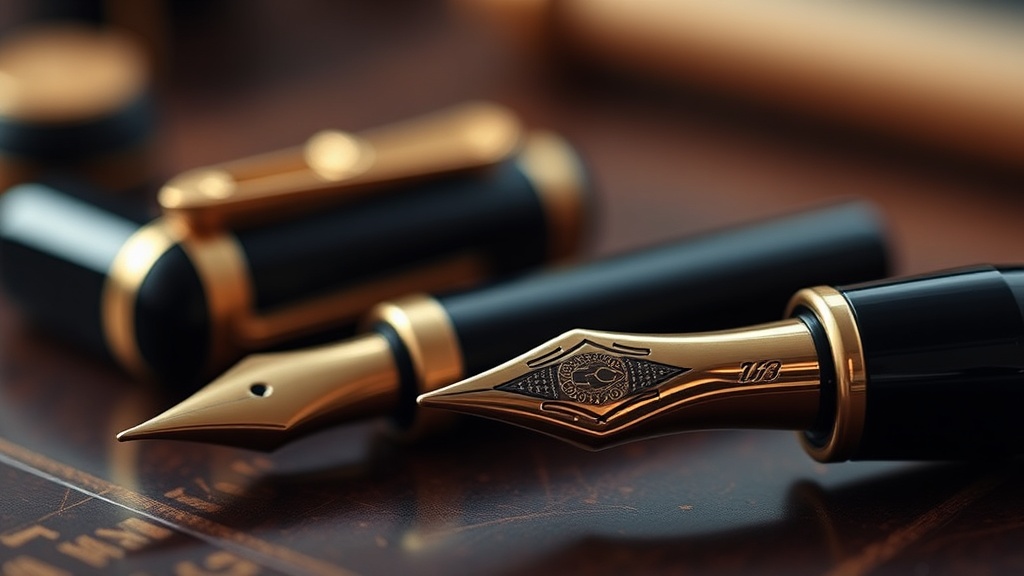
5 Must-Have Vintage Fountain Pens Every Collector Should Own

Parker 51: The World's Most Wanted Pen
Montblanc Meisterstück 149: The Summit of Luxury
Pelikan M400 Souverän: German Engineering Excellence
Waterman 52: Art Deco Elegance Personified
Sheaffer Balance: American Innovation at Its Finest
What Makes a Vintage Fountain Pen Worth Collecturing?
A vintage fountain pen earns its place in a collection through a combination of historical significance, build quality, nib performance, and scarcity. This post covers five specific models that represent the pinnacle of 20th-century pen manufacturing—each one a benchmark that collectors return to again and again. Whether building a foundation or hunting for that centerpiece piece, these pens offer provenance, writing excellence, and enduring market value.
Julian's spent fifteen years at the drafting table before turning full attention to pen restoration. That background means evaluating mechanism tolerances with calipers and understanding why certain feed designs simply work better than others. The tactile experience matters. A well-tuned nib on quality paper delivers feedback that no modern ballpoint can replicate.
Which Vintage Pens Hold Their Value Best?
Parker, Sheaffer, Montblanc, Pelikan, and Waterman dominate the vintage market with models that appreciate steadily year over year. That said, condition and originality matter enormously—a repainted Parker 51 won't command the same premium as one with factory-original lacquer. The market recognizes authenticity. Collectors pay for it.
Here's the thing about vintage pen investment: buy what you'll actually use. A cabinet full of mint-condition boxes won't bring the same satisfaction as five writers you rotate through regularly. The pens below strike that balance. Each represents a different approach to the same problem—moving ink to paper with grace and reliability.
1. Parker 51 (1941–1972)
The Parker 51 isn't just a pen—it's industrial design history. Launched in 1941, it remained in production for three decades with remarkably few changes to its core architecture. The hooded nib design keeps ink from drying out. The aerometric filler (introduced 1948) holds more ink than most modern converters. You'll find these in office drawers, estate sales, and auction houses worldwide.
The 51 comes in several variants that matter to collectors. The Vacumatic filler (1941–1948) uses a diaphragm mechanism that's trickier to restore but offers that satisfying thump when compressed. Aerometric models simplified maintenance without sacrificing capacity. Both work beautifully when properly restored.
What separates a $50 garage sale find from a $500 collector's piece? Factory-original finish. The "Cocoa" and "Forest Green" aerometrics command premiums. The Parker Pen Company archives contain detailed production records that help authenticate date codes and color variations.
Writing with a restored 51 reveals why draftsmen loved these. The fine-medium nib lays down a consistent line. The weight distribution—plastic barrel, gold-filled cap—creates that balanced feel in the hand. No fatigue during long writing sessions.
2. Sheaffer Lifetime Balance (1929–1940s)
Sheaffer's Balance line defined Art Deco pen aesthetics. The streamlined torpedo shape wasn't just beautiful—it balanced perfectly in the hand. The "Lifetime" guarantee (yes, they meant it) accompanied a nib that Sheaffer built to outlast its owner.
These pens feature the iconic White Dot on the cap—a mark of quality that Sheaffer maintained across decades. The Lifetime nibs came in several configurations, but the fine and medium points remain most collectible. Flex versions exist but grew rarer as the 1930s progressed and stiffer nibs became fashionable.
Restoration typically involves replacing the sac (a straightforward job) and cleaning the feed channels. The catch? Balance pens used several filling systems. The lever-fill is simplest. The Vacuum-Fil mechanism offers greater capacity but requires specialized knowledge to rebuild properly.
The PenHero reference site maintains detailed Sheaffer production timelines that help date specific models. Color matters enormously here—Carmine Red, Marine Green, and Black Pearl finishes command significant premiums over standard black.
3. Montblanc Meisterstück 149 (1950s–present)
The 149 represents the summit of factory production. That trademark resin—"precious resin" in Montblanc's marketing—feels warm and substantial. The piston mechanism operates with machined precision. The two-tone 18k nib remains a benchmark for smoothness.
Vintage 149s (pre-1990s) differ subtly from modern production. The nibs tend toward true medium and broad widths rather than the finer points favored today. The "spade" feed design evolved over decades—earlier versions often provide wetter flow that flex-nib enthusiasts prize.
Authentication requires attention. The snowcap star should be crisp, not molded. Serial numbers on vintage models follow patterns documented in collector references. The piston knob should turn smoothly with gentle resistance—grinding or looseness indicates wear or improper repair.
These pens aren't cheap. Even user-grade vintage 149s command several hundred dollars. That said, they hold value exceptionally well and offer writing experiences that justify the investment. The 149 sits at the center of many serious collections for good reason.
4. Pelikan 400NN (1950s–1960s)
German engineering meets fountain pen perfection. The 400NN improved upon the original 400 with a slightly larger barrel and refined piston mechanism. That iconic striped green barrel—translucent when held to light—reveals ink levels at a glance.
The piston filler in these pens operates with a smoothness that modern injection-molded mechanisms rarely match. Brass components, precision-turned. The difference is palpable every time you refill.
Nib options ranged from extra-fine to double-broad, with several italic and oblique grinds available from the factory. The 14k gold nibs provide that characteristic Pelikan bounce—springy without true flex. Writers either love this feedback or prefer something stiffer. Worth noting: Pelikan nibs from this era interchange with modern units, offering flexibility if preferences change.
The 400NN offers perhaps the best entry point into serious vintage collecting. Prices remain reasonable compared to equivalent Montblancs. Build quality matches anything from the era. Parts availability (thanks to Pelikan's conservative design evolution) means restoration stays straightforward.
5. Waterman 52 (1910s–1920s)
No vintage collection completes without experiencing true flex. The Waterman 52 delivers—perhaps more accessibly than any other model. These hard-rubber pens (black, red mottled, or woodgrain patterns) represent early 20th-century manufacturing at its finest.
The 14k Ideal nib responds to pressure with line variation ranging from hairline to broad stroke. Spencerian script, Copperplate, everyday cursive—whatever your hand, the 52 adapts. That responsiveness explains why calligraphers and handwriting enthusiasts still seek these century-old writers.
Hard rubber presents unique restoration challenges. Oxidation creates that characteristic "browning" on black models—sometimes desirable for patina, sometimes requiring stabilization. The lever-fill sac replacement is standard work, but the barrel threads need careful handling. Old hard rubber becomes brittle.
The Fountain Pen Network forums contain decades of Waterman-specific discussion that help identify rare variants. The 52V (slant-cap), 52½ (short version), and numerous imprint variations offer collecting depth that rewards research.
How Do You Spot a Restoration-Worthy Vintage Pen?
Look beyond surface grime. Check that the barrel isn't cracked (hold to light). Verify the filler mechanism operates—stuck levers or frozen pistons suggest dried ink or corrosion, both manageable but requiring different approaches. The nib should have tipping material intact; worn-down nibs can be retipped but that's specialist work.
Here's a quick comparison of the five pens covered:
| Model | Era | Filling System | Nib Type | Collectibility |
|---|---|---|---|---|
| Parker 51 | 1941–1972 | Vacumatic/Aerometric | Hooded fine-medium | High (common, but quality varies) |
| Sheaffer Balance Lifetime | 1929–1940s | Lever/Vacuum-Fil | Open 14k Lifetime | High (Art Deco appeal) |
| Montblanc 149 | 1950s+ | Piston | Open 18k two-tone | Very High (grail status) |
| Pelikan 400NN | 1950s–1960s | Piston | Open 14k | Moderate-High (best value) |
| Waterman 52 | 1910s–1920s | Lever | Open 14k flex | High (flex enthusiasts) |
Restoration philosophy matters. Some collectors prefer untouched originality—even if that means a dried-out pen that won't write. Others want functional writers. Julian's approach: preserve what's original, replace what fails. A new sac in a Sheaffer doesn't diminish history. A re-tipped Waterman nib? That's more controversial.
The tools required for basic restoration aren't exotic—ultrasonic cleaners, heat guns for section removal, shellac and talc for sac installation, micromesh for nib smoothing. The knowledge takes longer to acquire. Understanding feed geometry, recognizing when a nib has been ground down by decades of use, spotting reproduction parts—these skills separate successful collectors from those with drawerfuls of "projects."
Start with one pen. Learn its quirks. The Parker 51 makes an ideal first restoration—parts availability, plentiful documentation, forgiving mechanics. Graduate to more complex mechanisms as confidence builds. The Sheaffer Vacuum-Fil or early Montblanc pistons require specialized knowledge but reward patience with exceptional performance.
These five pens represent different eras, different design philosophies, different writing experiences. Together they form a collection that covers the golden age of fountain pen manufacturing. Each one teaches something different about what happens when engineers, craftsmen, and writers collaborate to perfect a simple act—putting ink on paper.
The hunt never really ends. There's always another estate sale, another auction lot, another forgotten drawer yielding treasure. The difference between collecting and accumulating? Using what you find. These pens were built to write. Honor that intention.