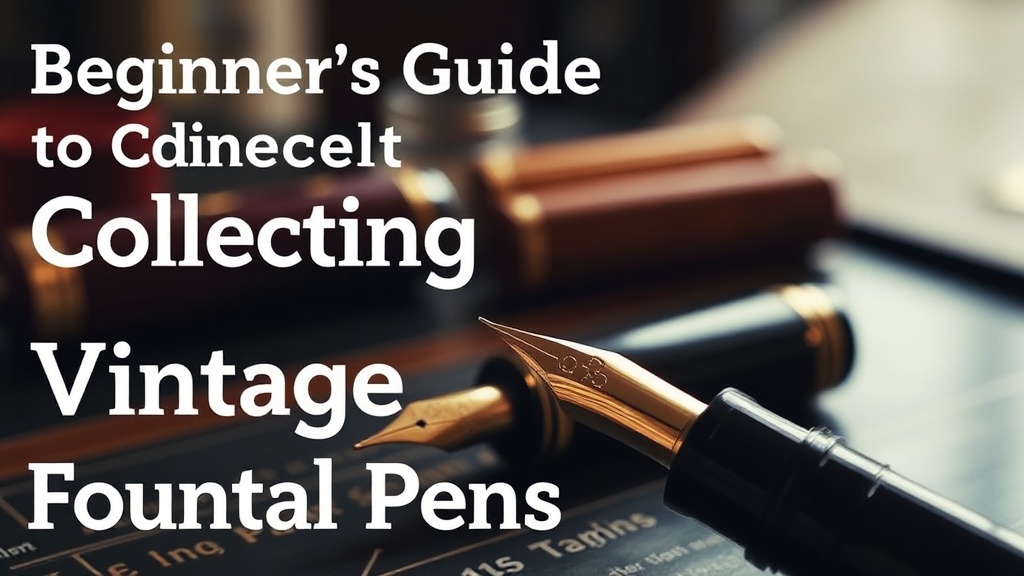
Beginner's Guide to Collecting Vintage Fountain Pens

This guide covers everything needed to start collecting vintage fountain pens without getting burned by cracked caps or mismatched nibs. You'll learn what physical condition actually matters, which brands built pens that survive decades of desk drawers, how much to budget for that first purchase, and where reputable sellers hide in plain sight. Whether you're drawn to the patina of a 1940s Parker or the tactile feedback of a well-tuned Waterman nib, vintage pens offer something no modern production line can replicate — a direct connection to the era when handwriting was craft, not convenience. Here's the thing: collecting isn't about deep pockets or auction houses. It's about knowing what to look for.
What should you look for when buying your first vintage fountain pen?
You should look for intact barrels and caps, an original nib that writes smoothly, and a filling mechanism that hasn't turned to dust. Cracks are the enemy. A hairline fracture in the barrel lip means the section won't seat properly, and cap cracks often indicate the pen was dropped or stored badly. Bring a loupe — or even a strong phone flashlight — and check the threads, the lip, and the finial.
The nib matters more than the name on the barrel. A generic steel nib on a sound body beats a cracked gold-nibbed grail pen every time. Here's the thing: many beginners get seduced by flex nibs they see on Instagram. Flex writing requires control. For a first pen, look for a firm medium or fine nib that lays down a consistent line without pressure. You can always chase the flex later.
Check the filling system. Sac pens — lever-fillers, button-fillers, aerometric fillers — use rubber ink sacs that harden over time. A missing sac isn't a dealbreaker; it's a $5 part and an hour's work. But a cracked piston mechanism in a vintage Pelikan? That's a different story. The catch? Some sellers call a pen "working" when it merely dips. Ask specifically: does it fill and write?
Worth noting: discoloration isn't always damage. Hard rubber pens darken with age. That's character. But chalky plastic — celluloid degradation — means the material is actively breaking down. Pass on those.
Cap rings and trim should sit flush. Loose cap bands indicate the celluloid or hard rubber has shrunk, which is nearly impossible to fix. Chrome-plated trim from the 1940s often shows brassing — wear through the plating — and that's acceptable on a user-grade pen. Complete absence of plating on a pen advertised as "excellent condition," though, suggests either dishonesty or ignorance. Both are reasons to walk away.
Nib alignment tells the real story. Hold the pen against a bright light and look at the tipping material. The two halves of the nib point should meet evenly. If one tine sits lower than the other, the pen will scratch or skip. Minor misalignment can be fixed with fingernail pressure or brass shims, but as a beginner, buy pens that write straight out of the gate. Or the box. Or the envelope.
Which vintage fountain pen brands are best for beginners?
Esterbrook, Parker, and Sheaffer produced millions of reliable pens that are still affordable and repairable today. These three American giants dominated the mid-20th century with designs that prioritized function and longevity. An Esterbrook J series from the 1940s or 1950s offers interchangeable nibs — called Renew-Points — so one body can host everything from a fine accountant's nib to a broad stub. They're plentiful, usually cost between $30 and $80 in good condition, and the screw-in nib units make maintenance straightforward.
Parker's 51 is arguably the most refined everyday vintage pen ever made. The hooded nib keeps ink from drying out, the aerometric filler is durable, and the build quality reflects Parker's engineering obsession. A user-grade 51 runs $80 to $150. That said, be wary of mismatched parts. The 51 was produced for decades, and caps, barrels, and nibs were swapped by repairers (and unscrupulous sellers) for years.
Sheaffer's Balance and Touchdown models deserve attention too. The Balance has that iconic simplified Art Deco shape, while the Touchdown filling system — a pneumatic single-stroke mechanism — is oddly satisfying to use. Sheaffer inlaid nibs from the 1960s write like glass across the page.
Waterman's 52 model deserves special mention. Produced from the 1910s through the 1930s, these hard rubber pens feature iconic "spoon" feeds and #2 or #5 nibs that offer remarkable smoothness. The 52 is a lever-filler, so maintenance is simple, and the black hard rubber — when not overpolished by eager restorers — has a depth that modern plastics simply can't match.
For those wanting European flavor, the Pelikan 140 and early Pilot Elite models offer excellent value. The 140 sports a partially hooded gold nib and a piston filler that's tough enough to survive seventy years with minimal fuss.
| Pen Model | Approximate Price (User Grade) | Filling System | Why It Suits Beginners |
|---|---|---|---|
| Esterbrook J | $30 – $80 | Lever-filler | Interchangeable nibs, plentiful parts, simple restoration |
| Parker 51 Aerometric | $80 – $150 | Aerometric sac | Hooded nib resists drying, rugged build, iconic design |
| Sheaffer Touchdown | $60 – $120 | Pneumatic single-stroke | Reliable filling system, smooth inlaid nibs, comfortable shape |
| Waterman 52 | $50 – $100 | Lever-filler | Classic spoon feed, excellent nib quality, straightforward repairs |
| Pelikan 140 | $100 – $180 | Piston-filler | Partially hooded gold nib, compact size, durable mechanism |
How much should a beginner spend on a vintage fountain pen?
You can build a respectable starter collection for under $300, with individual pens ranging from $25 to $150. The vintage pen market isn't the stock market. Prices fluctuate based on condition, rarity, and whether the seller knows what they've got. A battered but functional Esterbrook J might cost $25 at a flea market. The same pen, cleaned and with a fresh sac, might sell for $65 on a specialty forum. You're often paying for someone else's labor — and that's fine if you want to write, not tinker.
For a first serious purchase, $75 to $125 buys a lot of pen. In that range, expect a Parker 51 aerometric, a Sheaffer Triumph, or a higher-end Esterbrook with a desirable nib grind. Avoid the temptation to drop $400 on a first-generation Vacumatic as a beginner. Those pens are beautiful but finicky. The catch? Restoration costs add up. A $40 pen with a cracked cap plus a $50 repair equals a $90 pen that might still have issues.
Set a budget per pen and stick to it. Here's the thing: half the fun is the hunt. Scoring a Waterman 52 for $35 because the seller listed it as "old pen" beats paying retail every time.
Condition grading in the vintage pen world is informal but consistent. "User grade" means cosmetic wear but full function. "Mint" means the pen looks like it sat in a drawer since Truman was president. "Parts" means exactly that. Beginners should target user-grade pens. Mint examples carry premiums that are better appreciated after you've handled a few dozen specimens and understand what perfection looks like.
How do you restore and care for vintage fountain pens?
Most vintage pens need nothing more than a gentle cleaning, a new sac if they're lever-fillers, and occasional lubrication. Restoration intimidates newcomers. It shouldn't. Start with simple sac pens. Disassembling an Esterbrook J requires a rubber grip pad, a bit of patience, and maybe a heat gun on low. The old sac crumbles out, the feed and nib get an overnight soak in distilled water, and a new latex sac gets shellacked into place. That's it. (Well, almost — you also need to wait for the shellac to cure before filling with ink.)
Piston fillers demand more caution. Vintage Pelikans and Montblancs use cork seals and brass components that don't forgive ham-fisted disassembly. If the piston feels gritty or won't draw ink, send it to a professional. Organizations like the Pen Hero resource site list reputable repairers who specialize in specific brands.
For daily care, use fountain pen friendly inks — Waterman, Pilot Iroshizuku, or Pelikan 4001. Avoid shimmer inks and iron gall formulations in vintage sac pens; those particles and acids accelerate deterioration. Flush the pen every few months. Store it horizontally, nib up if capped, and never leave it in a hot car. Celluloid and hard rubber both react badly to heat and UV light.
Nib creep — that thin film of ink that climbs the slit — is normal. Excessive creep might mean the feed and nib aren't seated correctly. Cap liners, the felt or cardboard discs inside vintage caps, sometimes crumble and jam the nib. Replacing a cap liner takes five minutes and prevents ink evaporation. Details like this separate a pen that writes for a week from a pen that writes for years.
Where can you buy authentic vintage fountain pens?
eBay, Etsy, pen shows, and specialized forums like Fountain Pen Network remain the best hunting grounds for authentic vintage pens. eBay offers the widest selection but also the highest risk. Search for sellers with detailed photos — macro shots of the nib, the barrel imprint, the filling mechanism. Vague listings ("works great") without images of the nib slit or imprint should raise flags. Ask questions. A legitimate seller will answer them.
Etsy has emerged as a surprising source for restored vintage pens. Many sellers there specialize in cleaned and serviced pieces with clear photos and reasonable prices. The return policies are often friendlier than eBay's, and the sellers tend to be hobbyists rather than high-volume flippers. That said, "restored" on Etsy sometimes means "wiped with a cloth." Read the description carefully.
Pen shows are paradise for hands-on buyers. You can test the nib, check the balance in hand, and negotiate in person. The Fountain Pen Network community maintains show calendars and seller reputation threads that are worth reading before you attend.
Specialized retailers like Goulet Pens and Peyton Street Pens sell restored vintage stock with warranties. You'll pay a premium — sometimes 50% above raw auction prices — but you get a pen that's ready to write and a return policy if something's off.
The catch? Patience wins. The best deals rarely appear when you're desperate. Set up saved searches, check listings weekly, and don't impulse-buy a "rare" pen at 2 a.m. because the auction is ending.
Worth noting: estate sales and antique shops are underrated. The pens are often dirty, sometimes damaged, but priced as stationery rather than collectibles. A little knowledge goes a long way in those dusty glass cases.
Vintage fountain pen collecting rewards curiosity more than cash. A $40 Esterbrook with a fresh sac and a smooth nib writes every bit as well as pens costing ten times as much. The real prize isn't the rarity — it's the restoration, the research, and the moment a seventy-year-old nib touches paper and still performs flawlessly. Start small. Ask questions. Write often.