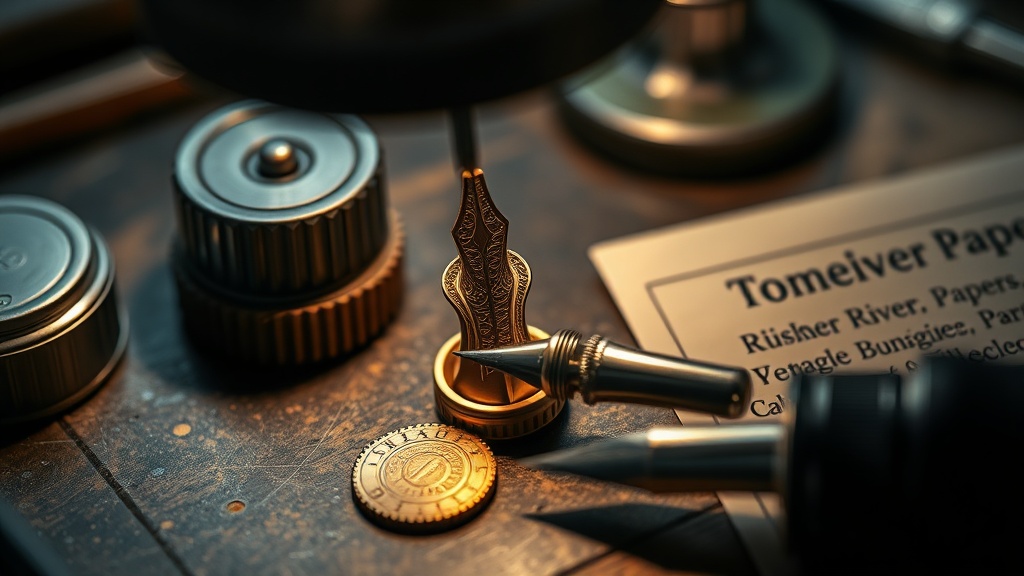
How to Rescue a Scratchy Vintage Nib Without Erasing Its Character

Why Your Vintage Nib Feels Scratchy (and How to Fix It Without Destroying It)
If a vintage pen feels scratchy, most people assume the nib is “shot.” They post the first blurry photo they can find, blame the pen for being “junk,” and reach for a replacement pen they’ll never finish using.
I’ve had enough of that mindset.
A scratchy nib is not a verdict. It’s a symptom.
And symptoms usually come from three causes: misalignment, micro-burrs, or feeding imbalance from ink and pressure. If you can diagnose those before you sand, the pen can often be brought back to life with less risk and better character than if you throw it on the bench for aggressive smoothing.
This is my clinic method, the one I use on restoration work I keep for years of daily writing.
Step 1: Stop guessing and clean the line path first
The first repair is not polishing. It is inspection.
- Flush the pen thoroughly and then fill it with fresh, not super-wet, ink.
- Write ten lines, slowly, with light pressure on a neutral paper sheet.
- Turn the pen 90 degrees, write again ten lines on the same sheet.
Why the rotation test? A healthy nib keeps feel relatively consistent between angles. If scratch only appears at one angle, you’re usually looking at tine asymmetry or a tipping edge issue, not “just a scratchy nib.”
If all directions feel the same and still scratchy, pause. Most people jump to micro-mesh now, but they’re often masking a deeper issue in flow first.
The quick flow check
Let the pen rest open nib-down on plain absorbent paper for twenty seconds.
- If a hard start appears every few lines after pause, suspect feed-starvation and not polish.
- If one side digs and drags even when the pen is freshly filled, suspect misalignment.
- If the line is gritty even with low pressure, it may be tip surface damage from overuse.
I don’t skip this step because it tells you the order of operations. On the bench, sequence beats brute force.
Step 2: Align the tines before you smooth anything
People think “scratchy” means “rough.” Not always.
A tine pair out of parallel creates a knife edge even when both sides look mirror-clean under a loupe. Under writing pressure, one tine leads; your paper gets a tiny ridge.
- Wipe the nib clean and dry.
- Place a white background behind the tip and inspect with 10x to 20x magnification.
- Use a brass shim or a thin stainless feeler to compare tine height and opening.
I use a brass shim because I want a rigid reference, not a soft push. The shim gives you a hard edge to reveal where one tine is stepping early.
If one tine is higher:
- Don’t polish yet.
- Gently nudge lower tine alignment with controlled pressure only, checking every two to three strokes.
- Re-test at 45° and 90° again before moving on.
This step is tedious. It’s also where most expensive mistakes happen if skipped.
Step 3: Remove only “burr” feel, not tip texture
Now the nib is aligned and feeding reasonably. You still want a glassy writing feel.
My rule: start with 4000 grit and finish at 12000, and stop before glossy optimism sets in.
When people ruin nibs, they usually do it in two ways:
- Too much pressure on too smooth a compound.
- Polishing the top of the tines instead of the writing edge.
Neither helps a nib that is structurally wrong.
Micro-mesh sequence
- 4000-grit: tiny passes, only on the point of contact.
- 6000-grit: same path, same angle.
- 8000-grit: only if needed.
- 12000-grit: final kiss.
One sentence warning: if your tip has already gone shiny in one area, quit for the day and test. Once you over-cure the edge, you can’t unwrite that confidence back. You can only recover by rebuilding with different geometry, which is much harder than a good first pass.
Step 4: Test at writing speed and pressure that resembles your real hand
Your hand is the final tool for verification.
A bench test done with camera-level delicacy is a lie. You write letters the way you actually write—sometimes rushed, slightly uneven, with a pause and a turn.
Do this after each pass:
- 20 slow lines (light touch)
- 20 normal pace lines
- 20 lines at slightly faster rhythm
Watch for:
- intermittent skipping,
- harsh high points in downstrokes,
- hard starts after pauses,
- sudden line weight spikes.
If all four are stable, the pen can live.
Step 5: Finish flow after shape
A lot of “scratchy nib” jobs fail because flow compensation was done first, then shape was ignored.
After surface work, tune flow by:
- adjusting converter seal and pressure path,
- ensuring no old, sticky ink remains in the slit,
- confirming the feed channel is clear.
If flow is still lean, don’t go thicker on ink right away. Fix airflow and internal capillary support. The pen should perform on normal ink before you move into your special boutique formulas.
I’m blunt about this because over-filling the line is the second path to “dead” nibs. We all want wetness for drama. We also want reliability.
The “do not do this” list I wish someone had shouted in my first month
- Do not twist and twist a stubborn nib in a vise.
- Do not use improvised sandpaper from hardware drawers.
- Do not chase gloss.
- Do not over-correct once the edge is starting to blur.
- Do not polish a misaligned nib to “make it feel smoother.”
That last one is where most repairs fail. If alignment is wrong, the pen will feel worse with every pass because the geometry is trying to scrape itself back into shape.
A short rule I use every morning
I keep one line written on the bench: alignment, not cosmetics.
Before I touch mesh, I decide if the failure mode is structural. If yes, I align first. If no, I smooth with minimum pressure.
This is the same logic behind why I restore old pens instead of replacing them. A correctly tuned nib with a minor edge issue can feel better in an evening than a new pen with no soul and no setup. If a pen has a history, it deserves a proper diagnosis, not a panic pass.
Why this matters
There is a bigger reason people ask this question. A scratchy nib is often treated like a cheap defect and then ignored. But if you stop at symptoms, you keep buying pens you don’t understand.
I’d rather keep the old Parker and Sailor units that built my routine. They teach me how materials age, how feeds behave, how paper and ink react, and why repair is slower and better than replacement.
If you own at least one vintage pen and one stack of paper with memory, this routine is your starting point, not a miracle trick.
Current inking testbed
- Pen: Parker 51 Aerometric, original 12k flex channel restored nib
- Ink: Diamine Ancient Copper (for flow tracing)
- Paper: Midori MD Cotton
- Check-in reference: The Last of the 52gsm: What Happens When the World’s Best Fountain Pen Paper Runs Out
- Method continuity post: The Nib Width Lie: Your Japanese Fine Is My European Extra-Fine
This post is for the person who wants to keep writing, not to create another decorative object on a shelf.