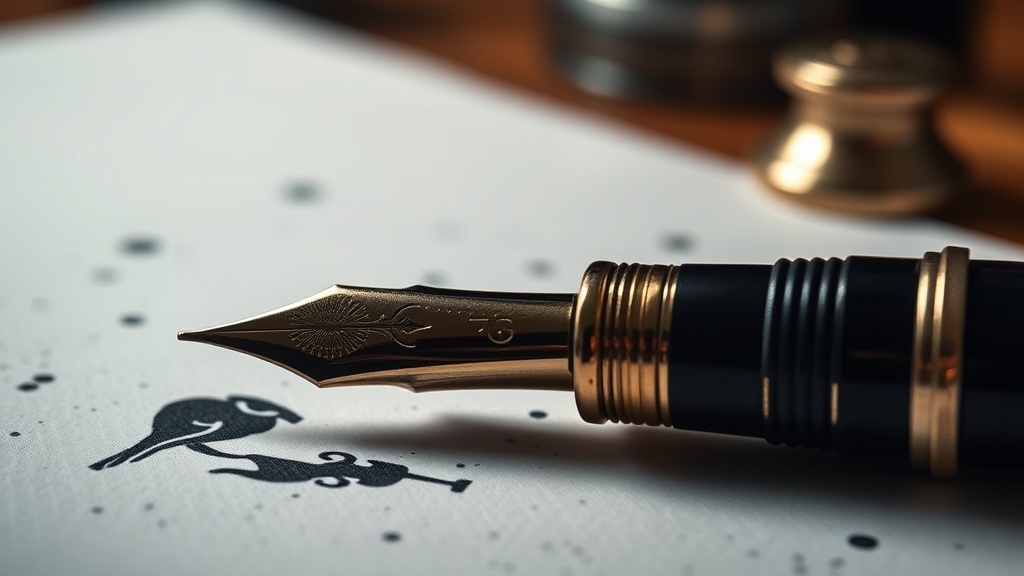
How to Stop Fountain Pen Ink From Feathering — Selecting the Right Paper Stock for Your Collection

Your extra-fine nib might write like a broad on the wrong paper. Independent testing by stationery engineers shows that line width can vary by up to 30% depending on paper stock — meaning that precise architectural line you expect from your vintage Japanese pen could blob and spread into an unrecognizable mess on inferior paper. For collectors who've invested hundreds (sometimes thousands) into carefully curated fountain pens, using cheap copy paper is like mounting a museum-quality watercolor on cardboard. This guide will walk you through identifying paper that honors your collection's performance, testing methods that save you from expensive mistakes, and the specific characteristics that separate archival-worthy stock from gas-station notebook fodder.
What Causes Fountain Pen Ink to Feather and Spread?
Ink feathering occurs when liquid ink bleeds outward from the intended line along individual paper fibers — creating that hairy, fuzzy edge that makes your careful script look like it was written on a coffee filter. The culprit isn't your pen, and it isn't (usually) your ink. It's the paper's internal structure.
Paper is essentially a mat of cellulose fibers — wood pulp, cotton, or a blend. In cheaper papers (think standard printer paper or drugstore notebooks), these fibers are loosely packed and highly absorbent. When fountain pen ink — which flows more freely than ballpoint paste — hits this surface, capillary action pulls it rapidly through the gaps between fibers. The ink spreads laterally along these pathways, creating feathered edges. Higher-quality papers undergo "sizing" — a process where the manufacturer adds gelatin, starch, or synthetic resins to fill these gaps and create a barrier that keeps ink near the surface.
The sizing agent matters enormously. Too little, and ink bleeds through (show-through or ghosting). Too much, and ink sits on top forever, smudging at the slightest touch. Premium fountain-pen-friendly papers use "hard sizing" — enough to control absorption but not so much that the ink can't bond with the surface. Cotton content helps too; longer cotton fibers create a tighter, more uniform surface than cheap wood pulp. This is why a 90gsm cotton paper often outperforms a 120gsm wood-pulp stock — weight isn't everything when it comes to fountain pen performance.
There's also the matter of surface texture. From my drafting background, I learned that tooth (surface roughness) affects line precision dramatically. Paper that's too smooth (highly polished coated stock) can cause ink to pool. Paper that's too rough (cold-pressed watercolor paper) catches the nib and creates skipped lines. Fountain pen paper needs what engineers call "micro-texture" — enough surface irregularity to break the surface tension of the ink droplet, but not enough to snag delicate vintage nibs.
How Can You Test Paper Before Buying a Full Ream?
Before committing to a $30 notebook, you need reliable testing methods. I've developed a three-point inspection system over fifteen years of evaluating paper — first for technical drawings, now for fountain pen collection management. You don't need a microscope; just good lighting and a drop of water.
The Light Test: Hold a single sheet up to a strong light source. Quality fountain pen paper shows uniform fiber distribution — you shouldn't see dark clumps or bright pinholes. Those bright spots are thin areas where ink will bleed through. Japanese papers like Tomoe River excel here — despite being thin (52gsm), they're remarkably uniform. If you see obvious fiber clumping, put the paper back.
The Water Drop Test: Place a single drop of clean water on the paper and observe for ten seconds. On properly sized paper, the drop will bead slightly before slowly absorbing, maintaining a defined edge. On unsized or poorly sized paper, the drop spreads immediately into an irregular circle with feathery edges. The faster the feathering, the worse the paper will perform with fountain pen ink. This test mimics how ink behaves — water-based fountain pen inks respond similarly, though often more dramatically.
The Writing Sample: If the store allows, test with your own pen. Use a wet-writing broad nib if you have one — if the paper survives that, it'll handle anything. Write your name, hold the page at arm's length, and check for show-through (visible from the back) and bleed-through (ink actually marking the next page). Slight show-through is acceptable in thin papers; actual bleed-through means the paper is unsized and unsuitable.
The Smudge Test: Write a line, wait five seconds, then drag a finger across it. Fountain-pen-friendly paper allows the ink to dry quickly on the surface rather than soaking in slowly. If you're still getting smudges after ten seconds, the sizing is either too heavy (ink sits wet) or too light (ink soaks deep but hasn't dried). Either way, it's not optimized for fountain pen use.
Which Paper Characteristics Work Best for Different Nib Types?
Your vintage nib collection probably includes everything from needlepoint Japanese extra-fines to juicy vintage Waterman flex nibs. Each has different paper requirements.
Extra-Fine and Fine Nibs: These nibs deposit less ink, so they can handle slightly more absorbent papers without feathering. However, the fine line they produce means any paper texture will be noticeable — rough paper creates a scratchy, unpleasant feedback. Look for smooth "hot-pressed" surfaces. Clairefontaine Triomphe and Rhodia's standard lines work beautifully here. The smooth surface lets the nib glide while the hard sizing prevents the fine line from spreading.
Medium and Broad Nibs: These wetter nibs need more sizing to prevent feathering. You'll want at least 80gsm weight (preferably 90gsm) with hard sizing. The additional ink flow of a broad nib can overwhelm thin or poorly sized paper, causing both feathering and bleed-through. This is where Tomoe River paper defies logic — despite being only 52gsm, its unique sizing handles broad nibs beautifully, though with some show-through. For double-sided writing with broad nibs, look to 100gsm+ papers like those from Fabriano or the heavier Maruman Mnemosyne lines.
Flex and Italic Nibs: These are the paper killers. Flex nibs vary from hairline to triple-broad in a single stroke; italic nibs have sharp edges that can catch on textured paper. You need both smoothness (for the flex variation) and durability (for the sharp edges). I've found that Midori MD paper — with its slight tooth but excellent sizing — handles flex nibs well. The paper "gives" slightly under pressure, protecting vintage nibs while controlling ink flow.
Wet Writers: Some vintage pens — particularly certain Parker Vacumatics and early Sheaffers — are notoriously wet. For these, you need heavily sized paper. Tomoe River excels here (ironically, given its thinness). Alternatively, look for "ink-resistant" papers designed for marker and fountain pen use. These have polymer coatings that create a true barrier.
Where Can You Find Paper Worthy of Your Collection?
The good news: fountain pen friendly paper is more available than ever. The bad news: marketing claims often outpace performance. Here's where to look.
Japanese Imports: Japan produces some of the world's finest fountain pen paper — unsurprising given their fountain pen culture. JetPens carries an extensive range of Tomoe River, Midori MD, and Maruman Mnemosyne. Tomoe River is legendary among collectors for showing off ink sheen and shading, though its thinness isn't for everyone. Midori MD offers a more traditional writing experience with excellent durability. These papers use advanced sizing techniques developed for Japan's humid climate — they resist feathering even in challenging environments.
European Stationery: French paper-maker Rhodia has been the gold standard for decades. Their "R" premium pad uses pH-neutral, acid-free stock with Clairefontaine's famous smooth finish. For archival work, look to Goulet Pens' house-brand notebooks or the Italian Fabriano EcoQua lines — these use cotton blends and are explicitly marketed as fountain pen friendly. European papers tend to be heavier than Japanese equivalents; a "light" Rhodia is often 80gsm, equivalent to a "heavy" Japanese stock.
Testing Samplers: Before committing to a full notebook, buy sampler packs. Several retailers offer "paper sampler" packs with 5-10 sheet samples of different brands. This is invaluable for testing how your specific pens — especially vintage ones with unique flow characteristics — interact with different papers. The Fountain Pens subreddit maintains a wiki of tested papers, and members often trade samples.
Storage matters too. Even perfect paper degrades if stored poorly. Keep your notebooks away from direct sunlight (UV degrades sizing agents), away from heat sources, and in moderate humidity. I store my unused notebooks in archival boxes with silica gel packets — excessive moisture can activate sizing agents prematurely, creating sticky pages. If you're serious about preserving both pens and paper, treat your paper stock with the same care you give your vintage celluloid.
Remember: you're not just buying paper. You're buying the substrate that translates your pen's mechanical precision into visible art. A $500 vintage pen deserves better than 20lb copy paper. Choose stock that respects the engineering in your hand, and you'll discover dimensions to your collection you never knew existed.