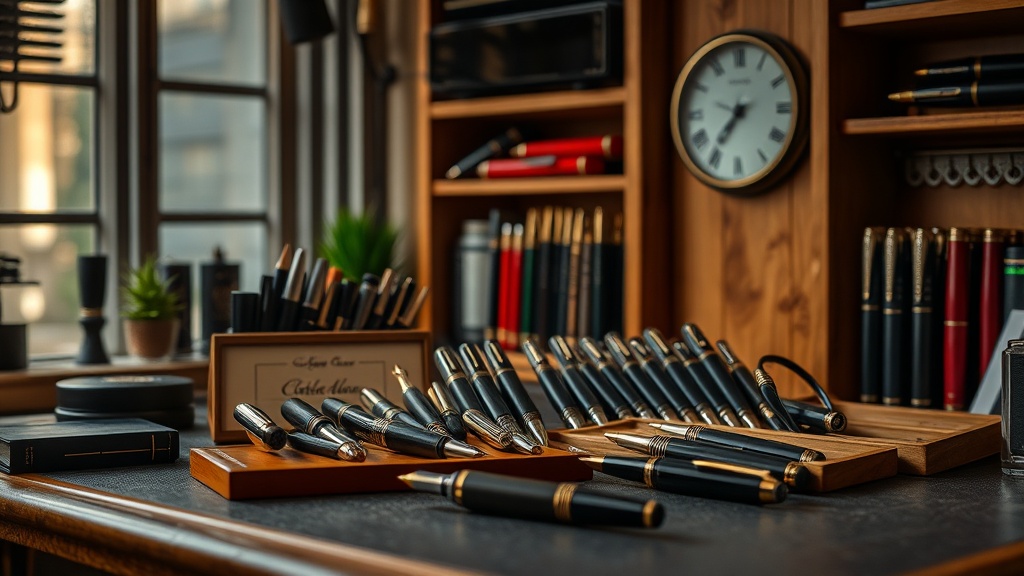
How to Store and Display Your Fountain Pen Collection Like a Pro

A fountain pen collection represents more than ink and metal—it carries stories, craftsmanship, and often significant value. Whether you've accumulated three beloved daily writers or three hundred rare vintage pieces, how they're stored and displayed directly affects their condition, longevity, and the pleasure derived from owning them. This post covers practical storage methods, professional display options, and protection strategies that keep every nib ready to write and every barrel looking its best.
What Is the Best Way to Store Fountain Pens Long-Term?
The best long-term storage method depends on whether the pens are inked. Uninked pens fare well in almost any clean, stable environment. Inked pens, however, need more care—dry environments can cause evaporation, while humid spaces invite mold and corrosion. For collections that sit unused for weeks or months at a stretch, empty the ink completely, flush the feed and nib with distilled water, and allow every part to dry before storage. (A bulb syringe makes this faster than you might expect.)
Once clean, pens belong in a case or drawer that shields them from light, dust, and temperature swings. Wooden boxes with felt lining look handsome but can trap moisture; instead, consider a lined leather case like those from Goulet Pens or a dedicated pen cabinet with adjustable dividers. For collectors managing dozens of pieces, the Galen Leather Co. Forty Pen Case offers individual slots and a rigid structure that prevents pens from knocking against one another during transport or prolonged storage.
Here's the thing: even premium cases fail if the surrounding environment is hostile. Aim for relative humidity between 40% and 55%. Basements and attics are usually poor choices. A closet in a climate-controlled room works better. If you live in a region with extreme seasonal swings, toss a small silica gel packet into the storage container—but not directly against celluloid or hard rubber barrels, which can dry out and crack over time.
How Should Fountain Pens Be Stored? (Nib Up or Down?)
For inked pens, store them horizontally. This keeps the ink evenly distributed across the feed and prevents it from pooling in the cap (nib down) or draining away from the nib entirely (nib up). Horizontal storage is the safest default for virtually every filling system—cartridge, converter, piston, and eyedropper alike.
The catch? Some collectors swear by nib-up storage for pens that leak. While vertical nib-up positioning can reduce the risk of a surprise ink bath, it also encourages air bubbles and hard starts. A better solution is to address the underlying problem—a worn seal, an overfilled barrel, or a cracked nib housing—rather than relying on gravity as a bandage.
Worth noting: vintage pens with sacs or diaphragms (like many Parker Vacumatics or Sheaffer Balances) should always rest horizontally when inked. The ink needs to contact the feed consistently. Nib-up storage starves the feed and can cause the sac to dry unevenly, shortening its already finite lifespan. For display purposes, horizontal pen trays or slotted shelves solve this neatly.
What Are the Best Display Cases for Fountain Pen Collections?
Glass-topped display cases remain the gold standard for collectors who want visibility without sacrificing protection. A well-made case blocks dust, reduces handling, and turns a collection into a room's focal point. The Deco Brothers Wood Pen Display Box holds thirty-four pens under a hinged glass lid and fits comfortably on a desk or bookshelf. For larger collections, custom-built cabinets with UV-filtering glass are worth the investment—sunlight degrades celluloid, fades resin colors, and yellows clear demonstrator barrels over time.
That said, not every display needs to be a locked cabinet. Wall-mounted acrylic cases (like those sold by JetPens) work well for modern acrylic and resin pens that aren't light-sensitive. They're affordable, easy to mount, and keep pens at eye level where they can be admired. The trade-off is less protection from physical bumps and no humidity control.
| Display Type | Best For | Pros | Cons |
|---|---|---|---|
| Glass-top wooden box | Small to medium collections | Elegant, dust-proof, portable | Limited capacity; wood can trap moisture |
| UV-filtering cabinet | Valuable vintage pens | Maximum light protection, secure | Expensive, heavy, custom lead times |
| Wall-mounted acrylic case | Modern resin/acrylic pens | Affordable, visible, space-saving | No humidity control, vulnerable to bumps |
| Leather travel case | Active rotation pens | Protective, portable, stylish | Hidden from view, limited capacity |
For collectors who rotate pens regularly, a hybrid approach works best: keep the daily rotation in a leather desk tray or open wood stand (the Nock Co. Pen Well is a favorite), and store the rest in closed cases. This minimizes handling of the "museum pieces" while keeping the working writers accessible.
How Do You Protect Vintage Fountain Pens from Damage?
Vintage pens demand stricter rules than modern production models. Materials like celluloid, hard rubber, and early plastics are reactive, brittle, or prone to discoloration. Celluloid, in particular, is flammable and can off-gas camphor as it ages. Store celluloid pens away from heat sources, and never seal them in airtight plastic bags—they need to breathe, albeit in a controlled environment.
Hard rubber (ebonite) pens present a different challenge. They oxidize when exposed to light and air, developing a characteristic brown "bloom" that destroys their original black finish. Once blooming starts, it can't be reversed—only polished away, which removes material. The only defense is dark storage. A closed drawer or an opaque cabinet is non-negotiable for hard rubber pieces like early Waterman or Wahl-Eversharp models.
Here's the thing: handling is often more damaging than storage. Oils from skin transfer to barrels and nibs, attracting dust and promoting corrosion. When a vintage pen must be moved, grip it by the section or cap—not the barrel—and handle it with clean, dry hands. Some collectors keep cotton gloves nearby for moving high-value pieces. It looks dramatic, but it prevents micro-abrasions and tarnish on gold-filled trim.
For pens with gold nibs, corrosion isn't usually the worry; bending is. Gold is soft. A nib can be sprung by the slightest pressure against a case wall or neighboring pen. Individual slots—or at least soft dividers—prevent this. Never toss loose pens into a drawer. The clinking sound might be satisfying, but it's the sound of damage accumulating.
What Display Accessories Complete a Professional Setup?
Beyond cases and cabinets, the right accessories turn a pen collection into a curated presentation. A good loupe (10x magnification minimum) lets you inspect tines, tipping material, and engravings without handling the pen. The BelOMO 10x Triplet Loupe is the standard recommendation among restorers and serious collectors. It reveals hairline cracks, misaligned tibs, and the subtle wear patterns that indicate a pen's history.
Lighting matters too. Daylight-balanced LED lamps (5000K–6500K) show true colors and details without producing the heat that incandescent bulbs do. Position lights above or beside the display, never inside a closed case where heat can build. For collectors who photograph their pens for insurance or online communities, a small light tent and a neutral background card produce consistent, professional results.
Ink storage deserves its own mention. Bottles should stand upright in a cool, dark place. Diamine, Pilot Iroshizuku, and J. Herbin bottles all have different shapes, so adjustable shelving helps. Keep ink away from the pens themselves—spills happen, and a leaking bottle of Noodler's Baystate Blue can ruin a case lining (and anything it touches) in minutes.
That said, the most overlooked accessory is documentation. A simple spreadsheet or notebook recording purchase dates, prices, provenance, and restoration history adds value and protects the investment. For high-end pieces, a printed provenance card slipped into the case alongside the pen improves the presentation and provides context for anyone viewing the collection.
Whether the goal is preservation, display, or daily enjoyment, thoughtful storage separates the casual accumulator from the serious collector. Every pen— from a humble Pilot Metropolitan to a limited Visconti Homo Sapiens—deserves a home that respects its mechanics and its history. Start with the environment, choose the right case for each tier of the collection, and handle every piece with the care it took to create. The reward isn't just protection. It's the quiet satisfaction of opening a display case and finding every nib exactly as it should be—ready to write another chapter.