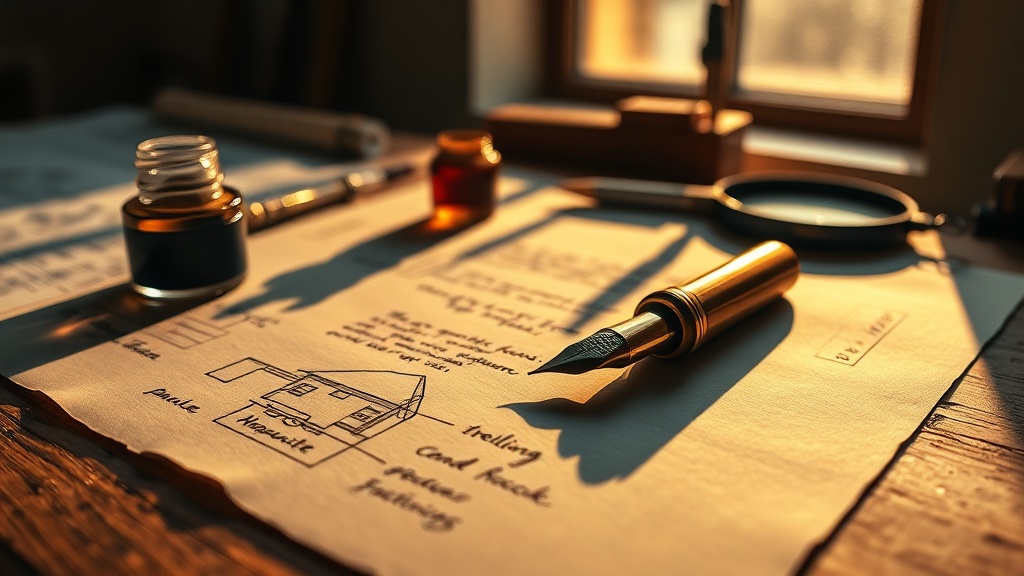
The Copper That Writes Like Weather: Diamine Ancient Copper and the Spring Ink You've Been Sleeping On

It started with a Waterman Laureat that came in coated with what I assumed was thirty-year-old blue-black.
The pen had been sitting in a desk drawer in Beaverton since roughly 1993. The owner — the grandson of the original owner, who had mailed it to me — said his grandfather had "written everything with it." Letters. Grocery lists. A diary that nobody had read yet. The nib was caked, the converter fused to the body, the plastic gone slightly cloudy the way only old Waterman finishes do.
I spent forty minutes on the nib alone. Ultrasonic bath, then a long soak in cool water with a single drop of dish soap, then patience. When the converter finally came free and the dried ink began releasing — it wasn't blue-black. It was a warm, faintly reddish brown. A color that looked exactly like the sediment left in a copper pot that had held tea for too long.
I ran it through my reference binders. Nothing matched cleanly. But when I inked up a test pen with Diamine Ancient Copper to do my post-restoration flow check — the scritch-scratch on the first line of 52gsm stopped me cold. It matched almost exactly. And then I noticed how well the ink was performing on its own terms, independent of whatever mystery it had helped me solve.
I've had a Pelikan M200 loaded with it for nine days now.
What Diamine Ancient Copper Actually Does on Paper
Diamine is a long-running British ink manufacturer — the commonly cited founding date is 1864, which would make them older than the automobile, and their current operations are based in Merseyside. Whether that precise lineage holds up to archival scrutiny I can't say, but what I can say is that this is not a new or experimental company. Most collectors know them as the brand that makes Syrah and Salamander and Midnight Blue. Ancient Copper sits quietly in the catalog, unloved, looking like something your grandmother might have liked.
Your grandmother had good taste.
On Tomoe River 52gsm — still the only paper I use for bench testing because it reveals everything — Ancient Copper performs with almost architectural precision. Here's what I found:
Flow: Wet, but not spready. On a medium nib tuned to factory spec, it laid down a line with enough ink to show depth without pooling at the edges. On my Makrolon Lamy 2000 with the tines opened past factory, it gets almost luxurious — the kind of wet flow that lets you hear the feedback without fighting the paper. No skipping on my pens. No hard starts after capping for a full workday, in my use.
Shading: This is where Ancient Copper does something the mainstream review sites have never adequately described. In my testing, the color transitions from warm amber-copper in fine strokes to deep sepia-brown in pooled areas — not gradually, but with the tonal range of a quality watercolor wash. The shadows arrive where you'd want them architecturally: corners, tight curves, letter junctions where ink pools naturally. On a flex nib I'd expect it to be extraordinary. On the rigid medium I was using, it was already better than its reputation suggests.
Feathering: None I could detect on my papers. Clean edges on 52gsm, clean edges on Leuchtturm 1917 80gsm, and — this one surprised me — clean edges on standard copy paper, which is where most inks go to embarrass themselves. Your copy paper may vary; cheap stock is inconsistent. But on what I had on the bench, the dye stayed put.
Water resistance: Moderate, in my testing. This is not a document ink. A direct water hit will smear. But the casual splatter that happens when you're writing at a kitchen table leaves a readable trace. For a non-permanent dye ink, the stability was genuinely better than I expected. A week under desk lamp exposure showed no significant fading on my sample cards.
Dry time: Eight to ten seconds on 52gsm with a medium nib at room temperature, in my conditions. If you're left-handed, budget an extra few seconds on coated papers.
Why Nobody Talks About This
Ancient Copper doesn't photograph well.
In a sample card photo under LED lighting, it reads as flat brown-orange. It doesn't have the blue-green sheen that gets twelve thousand upvotes on pen forums. It doesn't shimmer. It doesn't shift colors at an angle. It just looks like warm, earthy brown ink, which in the current collector environment reads as boring rather than classical.
The fountain pen community has a shimmer problem. Since roughly 2018, when independent bottlers figured out that mica particles photograph beautifully and justify premium pricing, the review ecosystem tilted toward visual spectacle. An ink with shimmer gets a dozen dedicated posts. An ink that simply writes well every day — reliably, quietly, without demanding attention — gets a two-line mention in a "Diamine complete review" thread from 2016.
Ancient Copper has been in continuous production long enough that I've bought it twice, years apart — 2019 and this week — and the two bottles behave the same way on my bench. I can't swear Diamine has never quietly adjusted a formula; they're a manufacturer, not a museum. What I can say is that in my hands, across those two purchases, the consistency has been better than most of the other non-iron-gall inks in my cabinet. That's the claim. I'm not promising anything about bottles I haven't tested.
Mind you, it isn't perfect. The color is contextual — on bright white paper with a fine nib, it can read as pale, almost washed out. It wants a medium-to-broad nib on cream or natural-white stock, where the copper depth has room to develop. Pair it with bleached white and an extra-fine and you'll wonder what I'm talking about. Pair it with an F or M on Tomoe River cream and the shading opens up and you'll understand immediately.
Against the Usual Comparisons
The obvious comparison is Diamine Sepia, which runs darker and cooler — more gray-brown than copper-red. Sepia is a fine ink. Ancient Copper is more interesting: warmer, more variable, better shading range on quality paper, in my testing.
Waterman Havane sits in a similar register. Slightly more orange, slightly less shading depth, and it runs thinner — some find this elegant, I find it insubstantial. Havane is a sports car. Ancient Copper is a well-maintained truck that starts in January.
Noodler's Antietam is the obvious American challenger — a deep reddish-brown with decent water resistance. But Noodler's batch consistency has been a genuine problem in my experience. I've opened three bottles of Antietam over five years and gotten three different colors. With Diamine, at least across the bottles I've personally tested, I've known what to expect.
For pure permanence, De Atramentis Document Sepia does what no standard dye ink can do. It's a different category, built for archival use, and it behaves accordingly — thicker, slower drying, less forgiving in cheaply-built nibs. For daily writing on quality paper with reasonable handling, Ancient Copper does more than enough and causes you no trouble.
Why It Belongs in Your Spring Rotation
Spring ink hunting is about calibration. After months of writing through winter — when I tend toward darker, heavier inks: iron galls, blue-blacks, serious navy — the bench wants something that breathes.
Ancient Copper breathes.
The color is spring in the specific way spring feels at a drafting table: the quality of light through an east-facing window at seven in the morning, the warmth of new wood before it's been finished, the first line of a site plan on fresh paper. It's not the color of flowers or green shoots. It's the color of the earth that spring works on — the warm ground underneath, the functional base.
I've had the Pelikan M200 inked with it for nine days. The pen hasn't needed a prime since day one. I've used it for bench notes, client correspondence, and a letter to a friend in Ontario who collects vintage Pilots. Every time I uncap it, it starts.
That's the verdict. Not "gorgeous" — I have no patience for gorgeous when the ink won't start. Not "unique" — unique is a photography problem, not a writing problem. The verdict is: starts every time on my bench, shades better than its reputation, typically available at accessible prices from most Diamine stockists, and has been quietly doing this for longer than most of the forum consensus knows.
The Nib Doesn't Lie. And this nib, for nine days running, has had nothing to complain about.
Current Inking:
- Lamy 2000 (Makrolon), M nib — Iroshizuku Shin-kai
- Pelikan M200, F nib — Diamine Ancient Copper (on trial, day 9)
- Vintage Sheaffer Snorkel, M nib — iron gall, ongoing
Happy hunting, but watch the caps.