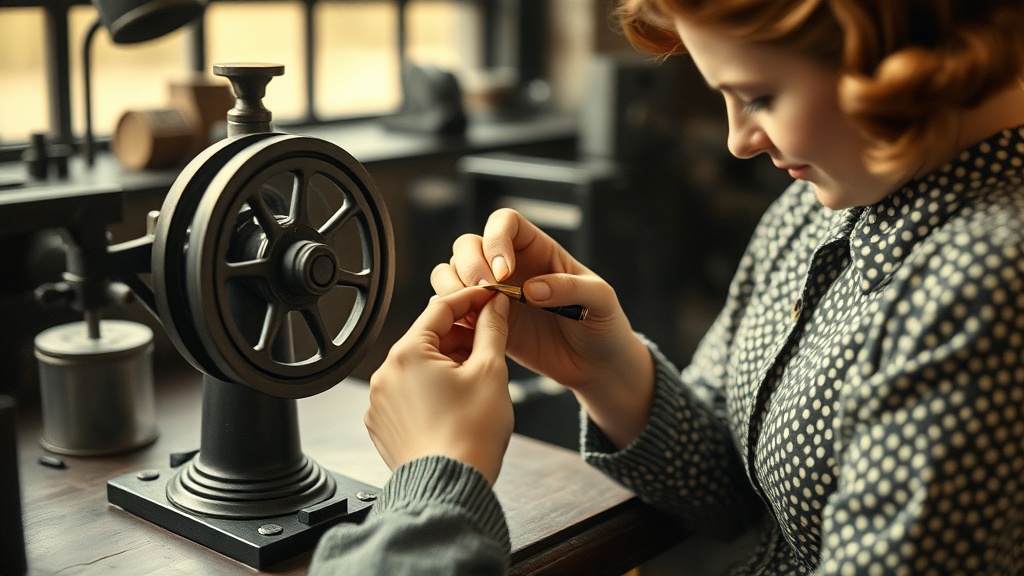
The Steady Hand: Women, Precision Work, and the History That Never Got Drawn

There's a type of photograph I've thought about for years. Production-floor shots from wartime pen manufacturing — Parker, Sheaffer, Esterbrook — that turn up in company archives and collector histories. Women at benches in headbands and work aprons, each one handling nib blanks with the kind of attention that precision work demands. Testing spring. Testing tine spread. Testing the thing that makes a fountain pen either a writing instrument or a piece of expensive frustration.
Their names aren't on the photographs.
I was a draftsperson for fifteen years. I sat at a table with T-squares and parallel rules and a rotation of pens — Rotring Isographs mostly, until I got into vintage and never looked back. In those fifteen years I worked alongside a handful of people whose line quality I still measure my own against. Some of them were men. The one whose architectural lettering was genuinely flawless — consistent 1.5mm height, freehand on vellum, no guide — was a woman named Carolyn. She left the firm before I did. Went to teach. The partners barely noted her departure.
That's been the pattern, in precision work, for a very long time.
The Production Floor Nobody Talks About
Fountain pen manufacturing at its peak — roughly 1920 through 1965 — relied heavily on women for the close-tolerance operations: nib testing, barrel polishing, ink-fill assembly. The precise gender breakdown varied by plant and era, and the historical documentation is thin enough that I won't pretend to give you percentages. What the labor history of American manufacturing does show, broadly, is that precision assembly work was disproportionately female-staffed — and disproportionately underpaid relative to the skill involved. The industry's stated reasoning was that women had better fine-motor sensitivity. That reasoning also justified keeping wages low. Both things were true simultaneously.
Mind you, that accounting is its own grim ledger. But the physical reality is this: the fountain pens that show up at my bench — the Parker 51s with nibs that still run butter-smooth after eighty years, the Esterbrook SJs with steel that out-flex most modern gold — were tested and finished by hands that never got a byline.
The nib doesn't lie. But the historical record does, by omission.
Women working those production benches understood the physics of nib metallurgy in their fingertips. Not in textbooks. Not in training manuals. In the cumulative feedback of thousands of nibs run across a test wheel — the particular resistance of a spring that's set too hard, the almost-inaudible sound difference between a tine gap that's right and one that's a hair too wide. That's tacit knowledge. It lives in the body. It transfers through demonstration, not documentation.
When those factories modernized and reduced their headcounts, that embodied knowledge didn't get archived. It scattered.
The Architecture Parallel
In 1991, Robert Venturi won the Pritzker Architecture Prize. His creative partner of thirty years, Denise Scott Brown — who co-authored Learning from Las Vegas, who co-developed the theoretical framework that defined the work — was excluded from the award entirely.
A petition to retroactively include her was formally denied in 2013.
I left architecture because the click-clack of a mouse replaced the scritch-scratch of a loaded technical pen, and I couldn't reconcile myself to that trade. But there's a harder truth beneath that: the field I'd been trained in had been consolidating credit for decades. The hand-drawn presentation was often produced by a team. The named partners on the door were rarely the ones whose line weights you'd recognize from the drawings. That's not specific to architecture. It's a structural feature of precision-labor industries that requires close work and produces results with someone else's signature.
Julia Morgan — among the first women licensed to practice architecture in California, trained at the École des Beaux-Arts — produced over seven hundred buildings across her career. She was meticulous about her drafting. Her working drawings are, by the accounts of anyone who's studied them, extraordinary pieces of technical illustration in their own right. She died in 1957, three years before the AIA Gold Medal she should have received was awarded to someone else. She finally got the Gold Medal posthumously in 2014.
Sixty years late. With a loupe, the line still tells you everything about the hand that drew it.
What Survives
Here's the thing that keeps me at the bench: the knowledge survived. Not always in books. Often in hands.
The restoration community I've found myself in — the people who know how to resac a Vacumatic without cracking the blind cap threads, who understand that a Chilton wingless lever box requires a different approach than a standard lever, who can read a nib's grind angle under magnification and tell you whether it was finished by machine or by a skilled hand — that community is not predominantly male. Not even close. Online forums, pen show repair tables, the people answering obscure questions at 11pm about 1940s Wahl-Eversharp ink compatibility. Women are carrying an enormous portion of this institutional knowledge forward.
Whether that traces directly back to those production floors and drafting rooms, or whether it's its own separate lineage, I can't say with certainty. But when I look at the depth of tacit knowledge being transmitted through demonstration in today's restoration community — and at who's doing much of that transmitting — the parallel is hard to ignore. The thread didn't break. It just changed hands across decades without anyone noting the handoff.
When I'm stumped on a tricky restoration — last month it was a Chilton wing filler where the blind cap threads had been cross-threaded by a previous repair attempt — the person who talked me through the approach was someone I know from an online forum who's been doing restorations for twenty-two years. She has a handle, not a business name. I don't know if she has a professional background or purely a hobbyist one. What I know is her methodology was correct and her explanation was precise.
The nib doesn't lie, and neither does demonstrated competence.
An Estate Collection, and a Name Worth Saying
I processed a collection last month that arrived with a handwritten note tucked into the box: "My grandmother was a technical illustrator at Boeing from 1952 to 1971. These were her working pens."
Four Sheaffer Snorkels. All in need of resacs and a sac shelf cleaning. When I flushed the first one, what ran out was a decades-old dried remnant of a blue-black — probably Parker Quink, possibly an early Skrip — that had been sitting dry for fifty years. The nib, once cleaned, ran absolutely true. Tines perfectly aligned. Even wetness across the full width. No spring fatigue. No corrosion in the channel.
This woman had maintained her instruments through twenty years of daily professional use. She understood them as tools, not possessions. She kept them in working condition. She used them to draw things that got built — aerospace components, technical manuals, the visual documentation of complex systems.
Her name, from the note her granddaughter included: Ruth Ames.
I looked for her in the published history of Boeing's technical illustration department. She doesn't appear. That department produced documentation that kept aircraft in the air. The human beings who made it, at the drafting table level, generally didn't make it into the record.
The nib is still here. Ruth Ames is not in the archive. The disconnect between those two facts is worth sitting with.
What I'd Ask the Precision Tool Community
When you pick up an estate pen, ask yourself who used it. The default assumption tends to be: a man, a professional, someone who wrote important correspondence. Sometimes that's accurate. Often it isn't.
The Parker 51 on my bench last week came from a 1960s school collection — forty pens, all labeled with student names on pieces of masking tape. Fourteen of them are clearly women's names. Every one of those fourteen pens was in functional condition. The four worst-maintained pens in the lot, the ones with corroded filling systems and dried ink fused to the sac shelf, had male names on the clips.
I'm not drawing a universal conclusion from forty pens. But I'm not not drawing one either.
It's International Women's Day this week. I'm not going to give you a list of Famous Women Who Used Fountain Pens, because lists are not the point and Famous Women deserve better than a listicle. The point is quieter and, I think, more important:
Much of the institutional knowledge we inherit when we restore a vintage pen — the metallurgy, the spring tolerances, the understanding of how an ink's viscosity interacts with a particular channel geometry — passed through women's hands. Often without attribution. Often without documentation. The archive has a systematic bias toward the named and the visible, and the named and the visible have historically not been the people doing the close work.
That's a problem for the archive, not for the knowledge. The knowledge survived because it was held in practice, in demonstrated competence, in the kind of deep understanding that shows up not in what you say but in what you do when the tool is in front of you.
Ruth Ames drew things that got built. Those Snorkel nibs prove she knew what she was doing.
I'll be thinking about her when I put them back into service.
Current Inking:
- Pen: Lamy 2000, Medium — tines opened past factory spec, runs honest and wet
- Ink: Iroshizuku Shin-kai (deep blue-black, appropriate for records you want to last)
- Paper: Tomoe River 52gsm, old stock
Happy hunting, but watch the caps.