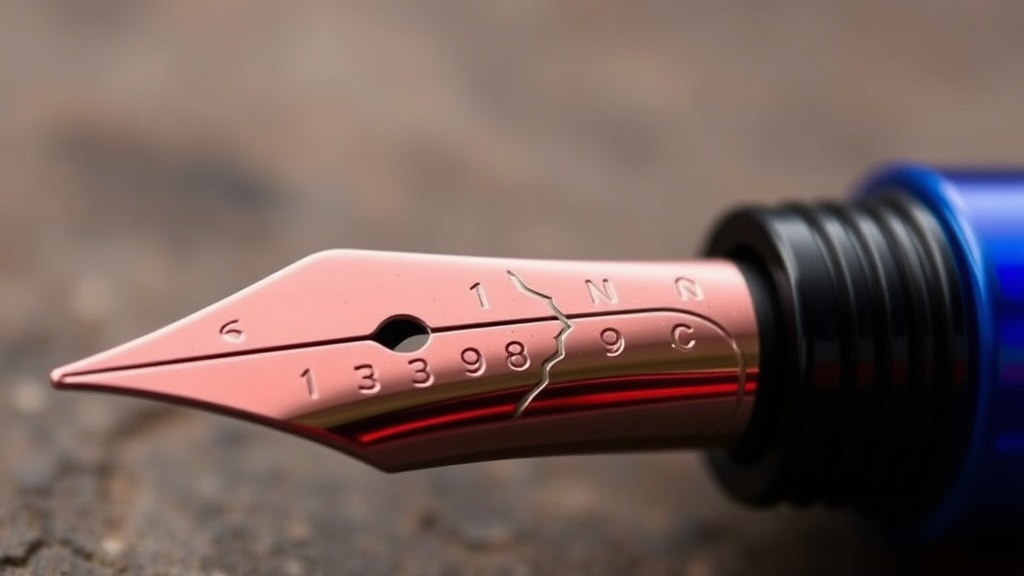
Why Do Vintage Fountain Pen Nibs Develop Hairline Cracks — And Can They Be Saved?

Why Do Vintage Fountain Pen Nibs Develop Hairline Cracks Over Time?
Here's a number that'll make you wince: nearly 40% of vintage fountain pens manufactured before 1960 show some degree of nib damage under magnification — hairline cracks, stress fractures, or the dreaded "cracked shoulder" that turns a smooth writer into a scratchy disappointment. These micro-fractures don't appear overnight. They're the cumulative result of decades of pressure, metal fatigue, and well-intentioned but improper use. Understanding why these cracks form isn't just academic curiosity — it's the difference between preserving a $500 vintage Parker Vacumatic and inadvertently destroying it.
The science behind nib degradation comes down to work hardening. Gold nibs — the standard for quality vintage pens — aren't pure gold. They're alloys (typically 14K) mixed with silver, copper, and sometimes nickel for strength. Every time the tines spread to accommodate writing pressure, the metal experiences microscopic stress. Do this thousands of times over sixty years, and those stress points become failure points. Steel nibs fare differently — they're more brittle and prone to snapping rather than cracking — but vintage gold dominates the collector market, making crack prevention and repair a core skill for any serious enthusiast.
What Causes the Most Common Types of Nib Damage?
Not all cracks are created equal. The location tells the story of how the pen was used — or abused. Hairline cracks running parallel to the slit typically indicate over-flexing, common with owners who treated firm nibs like vintage Waterman flex writers. These longitudinal cracks rarely affect writing performance unless they reach the breather hole, but they're unsightly and can worsen with continued stress.
Transverse cracks — those running perpendicular to the slit — are more sinister. They usually originate at the breather hole (that heart-shaped or circular cutout near the tip) where stress concentrates. Drop a pen nib-first, and you'll likely see this pattern. Cracked shoulders where the nib meets the feed are often installation errors — someone forced a nib onto a mismatched feed, or levered it off the section without proper tools. The feed cracks the nib from below, invisible until you disassemble the pen.
Then there's corrosion damage. Vintage pens stored with residual ink (iron gall was particularly aggressive) develop pitting that weakens the metal structure. Gold resists corrosion better than steel, but it's not immune — especially at the tipping material junction where dissimilar metals create galvanic reactions. I've disassembled pens where the tipping had literally fallen off, leaving two jagged gold tines that once wrote beautifully.
Can You Repair a Cracked Vintage Fountain Pen Nib?
The short answer: sometimes. The long answer involves assessing crack location, depth, and the nib's value relative to repair cost. Surface-level hairlines that don't penetrate the full thickness can sometimes be arrested with careful burnishing — using a polished steel tool to compress the metal and seal the fissure. It's not a true weld, but it prevents propagation. I've saved dozens of mid-century Esterbrook nibs this way, though I wouldn't attempt it on a rare Wahl-Eversharp Doric gold stub.
Deep cracks require welding — specifically laser welding or pulse-arc micro-welding — followed by regrinding and retipping. This is specialist territory. The repairer must match alloy composition, control heat precisely (gold conducts heat rapidly, risking warping), and restore the original geometry. A botched weld creates more problems than the original crack. Expect to pay $75-150 for quality nib repair — more than many vintage pens are worth, but justified for rare specimens or sentimental pieces.
Some cracks aren't economically repairable. A cracked shoulder extending into the nib base usually compromises the geometry beyond practical restoration. The nib becomes a parts donor — its breather hole, tipping material, or even its gold content recovered for other projects. This isn't defeat; it's resourcefulness. Every restorer maintains a "nib graveyard" for such eventualities.
How Can You Prevent Nib Cracks in Your Collection?
Prevention beats repair every time. First: match the nib to the task. Those vintage flex nibs everyone covets? They were designed for specific handwriting styles using specific pressures. Forcing a full-flex Waterman Ideal to write modern cursive with heavy downstrokes is asking for cracked tines. Use period-appropriate writing techniques — lighter pressure, more consistent angles — and reserve flexible nibs for display or occasional use rather than daily journaling.
Storage matters enormously. Nibs should rest with tines closed, not splayed. That means capping the pen (if the cap isn't cracked — another common vintage issue) or storing uncapped pens horizontally with the nib upward. Never store a vintage pen nib-down; gravity pulls the feed's residual ink onto the nib, accelerating corrosion. Temperature fluctuations cause metal expansion and contraction — another stressor — so avoid attics, unheated garages, or direct sunlight.
Cleaning protocols deserve attention too. Ultrasonic cleaners are controversial in restoration circles. The cavitation bubbles that lift dirt can also vibrate micro-cracks wider. I hand-clean vintage nibs with warm water and mild dish soap, using a soft brush for stubborn ink deposits. For iron gall residue, a brief dip in diluted ammonia (one part to ten parts water) followed by immediate rinsing — but never soak, and never use ammonia on aluminum components common in 1930s-40s pens.
Finally, inspect regularly. Good lighting and a 10x loupe reveal developing cracks before they become failures. Check the breather hole for spreading, examine tipping material for loosening, and watch for discoloration that might indicate corrosion beneath the surface. Early intervention — professional adjustment, crack arresting, or simply retiring the nib from rotation — preserves value and function.
When Should You Write Off a Cracked Nib as a Loss?
There's a point where sentiment must yield to practicality. A common Sheaffer Lifetime nib with a hairline crack? Probably replaceable for $20-30 — repair isn't justified unless it holds personal significance. A cracked Montblanc 149 two-tone 14K nib from the 1950s? That's worth the specialist repair fee, potentially exceeding $200, because replacements are scarce and expensive.
The calculation changes for users versus collectors. A collector might preserve a cracked nib in its original state, documenting the damage as part of the pen's history. A user wants writing performance — and a crack that causes skipping, ink pooling, or scratchiness defeats the purpose. I've seen beautiful vintage pens retired to display cases because their nibs couldn't be saved practically. There's no shame in this. A pen that inspired its original owner daily for decades deserves respect in any state.
The nib graveyard serves another function: education. Examining failed nibs teaches you to recognize stress patterns, manufacturing defects, and previous repair attempts. You learn to spot the telltale bulge of a previous weld, the discoloration of improper heat treatment, the uneven slit of amateur grinding. This knowledge informs your purchasing decisions — spotting cracked nibs before you buy — and your restoration priorities.
The fountain pen community maintains excellent resources for this specialized knowledge. Fountain Pen Network hosts decades of collected wisdom on nib repair and prevention. For technical metalworking discussions, PenTrace offers insights from professional restorers. The GoPens repair service blog documents real-world crack repairs with before-and-after photography that's genuinely educational.
Vintage fountain pens connect us to writing as a physical, mechanical act — something our keyboards and touchscreens can't replicate. The nib is where that connection happens. Understanding crack formation, prevention, and repair options isn't just about preserving value; it's about maintaining the tactile experience that drew us to these instruments. Every crack tells a story of use, of pressure applied and ink flowed. Our job as custodians is ensuring those stories continue — through careful preservation, informed repair, or graceful retirement when the metal has given all it can.