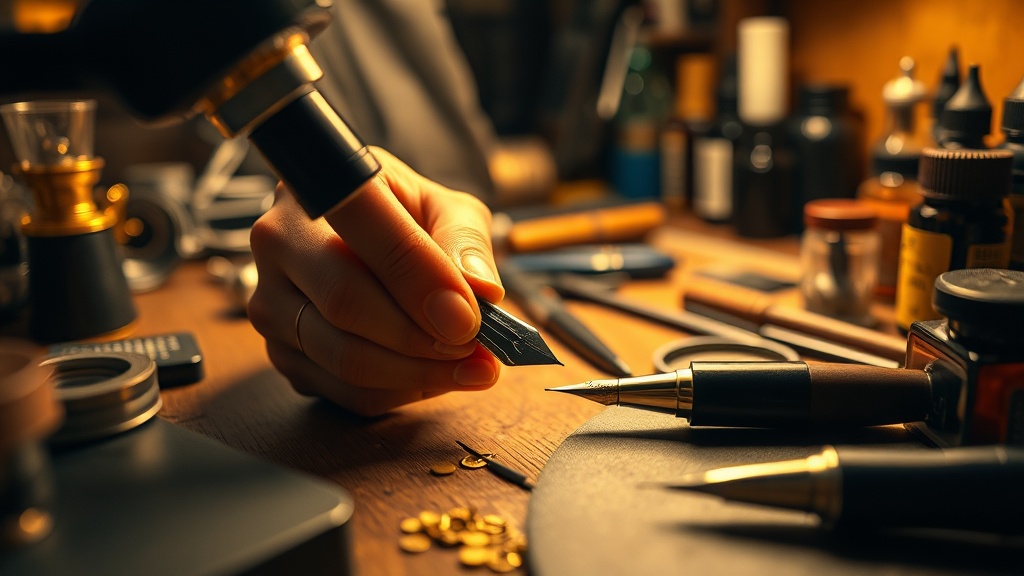
The Precision Edge: Women Rebuilding Fountain Pen Tech from the Nib Up

Every March, we get the same narrow definition of "tech": software launches, AI demos, venture funding charts, and someone in a blazer saying "disruption" like they invented the word.
I have no problem with software. I used CAD for years. I just refuse to pretend precision engineering only counts when it glows.
A fountain pen nib is a live fluid system. Two tines, one slit, one feed, a handful of channels, and a moving interface between air and ink that has to stay stable while your hand speed, pressure, and angle keep changing. If that isn't technical work, then neither is half the stuff people call innovation.
With International Women's Day on March 8, 2026, a day away, I want to widen the frame: women in tech includes the women building, tuning, and refining fountain pen mechanics in real time.
Reclaiming "Tech" for the Analog Bench
When people say fountain pens are "simple," what they usually mean is "I can't see the complexity."
The complexity is all in constraints. A nib/feed pair has to meter ink consistently, resist leaks, tolerate pressure changes in the reservoir, and recover after pauses. A 2020 paper in the Journal of Colloid and Interface Science supports what many repair folks see at the bench: capillarity alone doesn't explain reliable writing; ink-air balance and meniscus behavior matter.
That means your pen is balancing capillary action, surface tension, pressure drop, and air exchange at once, with no firmware patch coming to save a bad setup.
In practical terms, this is what nibmeisters work against every day:
- a slit that's too tight at the tip and starves flow,
- a tine pair that looks aligned until magnification says otherwise,
- polished tipping that feels "smooth" but crosses into hard-start territory,
- a grind geometry that looks perfect on paper but fails at the writer's natural rotation.
Nobody solving those problems is doing "craft" as the opposite of engineering. They're doing engineering with abrasives, magnification, and trained hand control instead of code commits.
The Shift in Mastery
In many 20th-century production lines, nib manufacturing roles and technical authority were male-heavy, especially at large firms. At the same time, plenty of skilled women did precision factory work that went under-credited in official histories. Either way, much of the practical know-how stayed locked inside factories and repair circles.
The modern custom-grind scene has changed who gets visible authority.
Take Gena Salorino at Custom Nib Studio. Their profile notes a four-year apprenticeship under John Mottishaw plus tuning workshops in Japan. In an Esterbrook interview, they describe a process any engineer would recognize: coarse grind, finer grind and polish, then final hand adjustment tied to user behavior.
That last part matters. The old commercial model leaned toward "standard tip, standard user." The independent specialist model is closer to "fit mechanics to the hand." If your rotation and pressure pattern are known variables, the nib can be tuned around them.
That isn't nostalgia. It's applied mechanical personalization.
You can see the same shift in other corners of the market. Audrey Matteson's SIG work at Franklin-Christoph and in-house customization programs built around specialists such as Anabelle Hiller at Appelboom helped normalize nib geometry as a configurable technical service, not just a boutique add-on.
The Physics of the Grind
Let's strip the romance out for a second.
A nib grind is material removal from hard tipping alloy where tiny changes alter three things at once:
- Contact patch with paper
- Ink film behavior at the writing edge
- Tolerance to user rotation
Change one, and you usually perturb the other two.
That's why good nib work is slow. The grind is only part of it. The real cycle is iterative: inspect, remove, polish, align, test, re-check flow, re-check edge behavior, then decide whether one more pass improves balance or breaks it.
Most writers only feel the end result as "this pen suddenly feels right." Under the loupe, "right" is a stack of tight compromises:
- enough edge definition for line character,
- enough rounding for usability,
- enough slit openness for sustained flow,
- enough capillary continuity that the feed keeps up,
- enough forgiveness for the user's angle on a Tuesday when their grip is off.
When people downplay nib grinding as artisanal flair, I assume they haven't watched someone hold those tolerances while preserving feed/nib harmony. One bad move means rework, or dead tipping.
Where Women Are Pushing Fountain Pen Innovation
The analog side of this hobby isn't frozen. The strongest technicians I know are blending old and new:
- microscopy and high-magnification inspection for earlier error detection,
- repeatable abrasive progressions for more predictable geometry,
- intake workflows (photos, writing samples, angle checks) to map user biomechanics before metal is touched,
- clearer documentation of grind profiles so outcomes can be taught and repeated.
That last one is the hinge. In my view, reproducibility is where craft starts becoming a discipline others can reliably learn. Once a grind style can be described, taught, and repeated across nib platforms, the work scales beyond one person's mystique.
Right now, many people driving that maturity are women working independently, in-house, or in hybrid shop roles that rarely get counted in mainstream "women in tech" narratives.
What to Celebrate on International Women's Day
On March 8, celebrate software engineers. Celebrate robotics teams. Celebrate chip designers.
Also celebrate the woman at a pen show bench who takes your stubborn nib, studies your writing angle, and hands back a tool that finally behaves in your hand.
I came to this hobby because I missed the sound of real work. The scritch of a tuned nib on thin paper is not anti-technology. It's technology you can hear.
If we're serious about honoring women in tech, we need to count micron-scale mechanical problem-solving in the analog world too.
Not adjacent to innovation.
Innovation.